Clinical context is the foundation of intelligence.
Generic language models lack clinical memory, evidence provenance, and hospital system context. The Helixis AI platform acts as a longitudinal clinical intelligence sidecar—or a complete 9-subsystem hospital operating platform—unifying disparate data streams into traceable context before generating physician-governed review drafts.
A single unified system from data ingestion to physician sign-off.
Rather than isolated point solutions, the Helixis AI platform orchestrates ingestion, validation, longitudinal projection, citation anchoring, and clinician review in one coherent pipeline.
Ingestion & Normalization
HL7 v2 and FHIR R4 interfaces ingest laboratory specimen telemetry, EHR consult notes, and pharmacy orders without modifying core software.
Longitudinal Timeline
Aligns multi-encounter patient history into an immutable, time-indexed event store with explicit handling of absent or delayed data.
Evidence-Aware AI
Drafts clinical summaries anchored in verified source evidence, automatically affixing interactive citation tags to every diagnostic assertion.
Physician Review Gate
Attending clinician verifies, modifies, and signs the documentation before any record is committed to the hospital system.
Engineered for clinical precision and institutional confidence.
Longitudinal Patient 360
Draws together encounters, laboratory results, medications, and historical notes from disparate hospital systems into a unified clinical trajectory.
Evidence Provenance & Citations
Every synthesized observation, diagnostic trend, and extracted fact links directly back to specimen timestamps, LIS analyzer IDs, or signed clinician notes.
Clinician-Controlled Drafting
Generates structured clinical consultation drafts and discharge notes strictly subject to professional physician modification, verification, and signature.
Explicit Epistemic Uncertainty
Distinguishes clearly between CONFIRMED, PENDING, REFERENCED_UNAVAILABLE, NOT_DOCUMENTED, NOT_RECENTLY_VERIFIED, CONFLICTING, and SUPERSEDED states.
How Helixis Clinical Intelligence Works End-to-End
Strong healthcare systems explain the clinical workflow with real product views and clear language. Below is the complete 5-step flow—from hospital-wide data collection and longitudinal Patient 360 assembly to the clinician review workspace and continuous record updates.
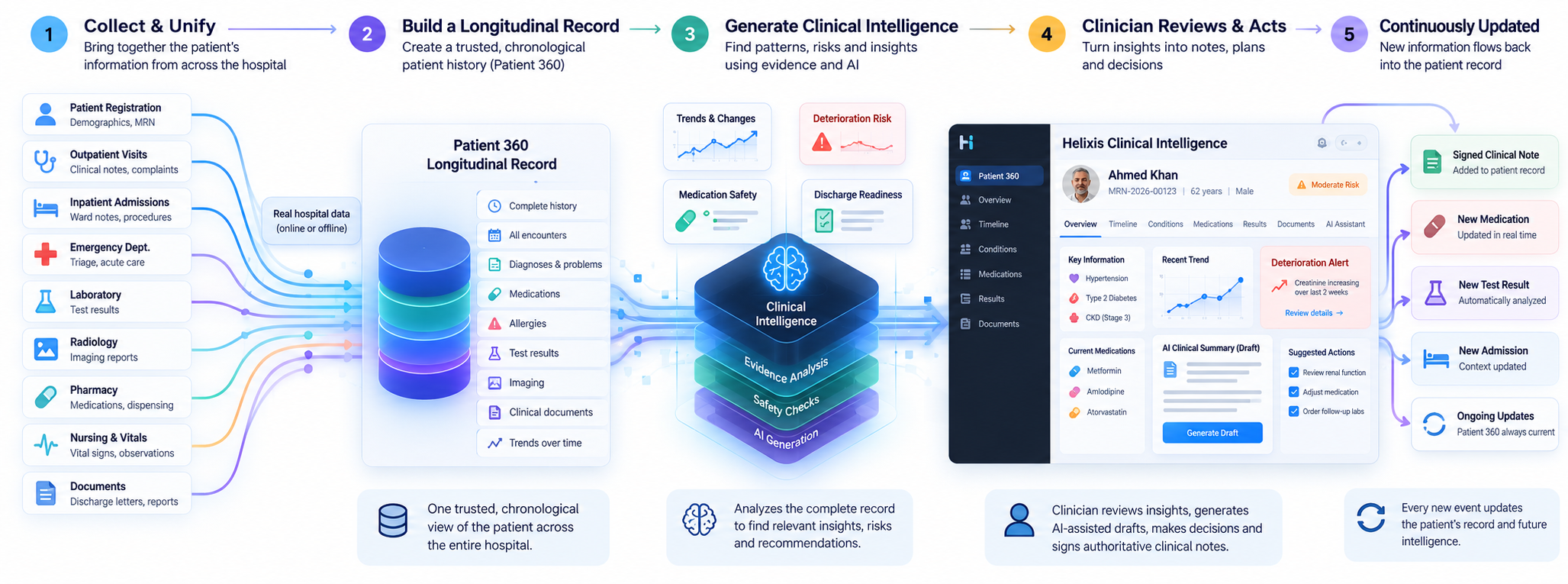
Collect & Unify
Brings together patient registration, outpatient visits, inpatient admissions, emergency care, lab results, radiology, pharmacy, nursing vitals, and clinical documents.
Build a Longitudinal Record
Creates a trusted, chronological Patient 360 history uniting encounters, diagnoses, medications, allergies, test results, imaging, and longitudinal trends.
Generate Clinical Intelligence
Analyzes the complete record to surface trends and changes, deterioration risks, medication safety checks, and discharge readiness.
Clinician Reviews & Acts
Presents real product views with key information, deterioration alerts, AI clinical summary drafts, and suggested actions for clinician review and sign-off.
Continuously Updated
Signed clinical notes, new medications, verified lab results, and new admissions flow directly back into Patient 360 in real time.
Patient 360: Real Product Views & Projection Architecture
Explore how clinical data from across the hospital is validated, unified into the Patient 360 longitudinal chart, and presented inside the Clinician Copilot workspace—replacing fragmented legacy module switching.
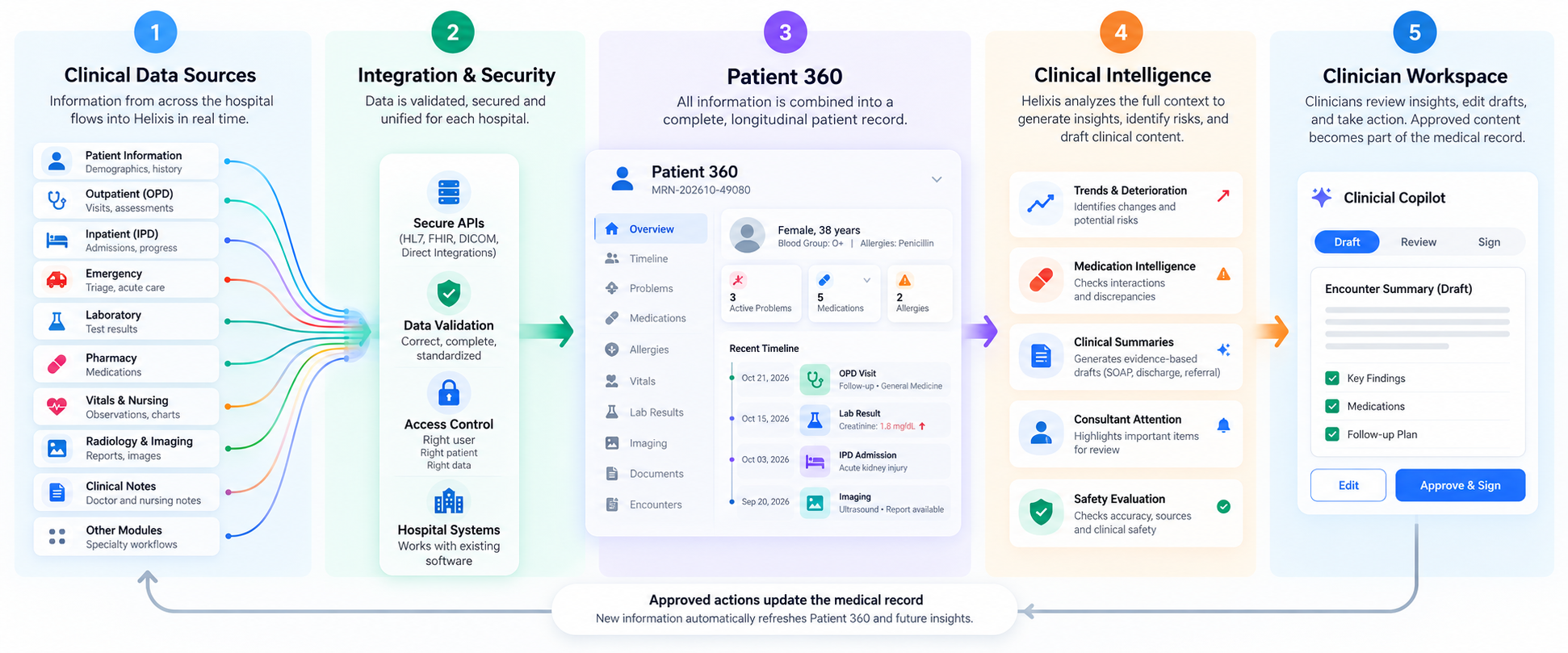
Clinical Data Sources
- Patient Information & History
- Outpatient (OPD) & Inpatient (IPD)
- Emergency Triage & Acute Care
- Laboratory, Pharmacy & Radiology
- Nursing Vitals & Clinical Notes
Integration & Security
- Secure APIs (HL7, FHIR, DICOM)
- Automated Data Validation
- Role-Based Access Control
- Works with Existing Hospital Software
Patient 360 Record
- Unified Longitudinal Patient View
- Active Problems, Meds & Allergies
- Chronological Encounter Timeline
- Lab Results, Vitals & Imaging
Clinical Intelligence
- Trends & Deterioration Detection
- Medication Interaction Checks
- Evidence-Based Clinical Summaries
- Consultant Attention & Safety Checks
Clinician Workspace
- Clinical Copilot (Draft, Review, Sign)
- Key Findings & Follow-Up Plan
- Clinician Edit, Approve & Sign
- Approved Actions Refresh Patient 360
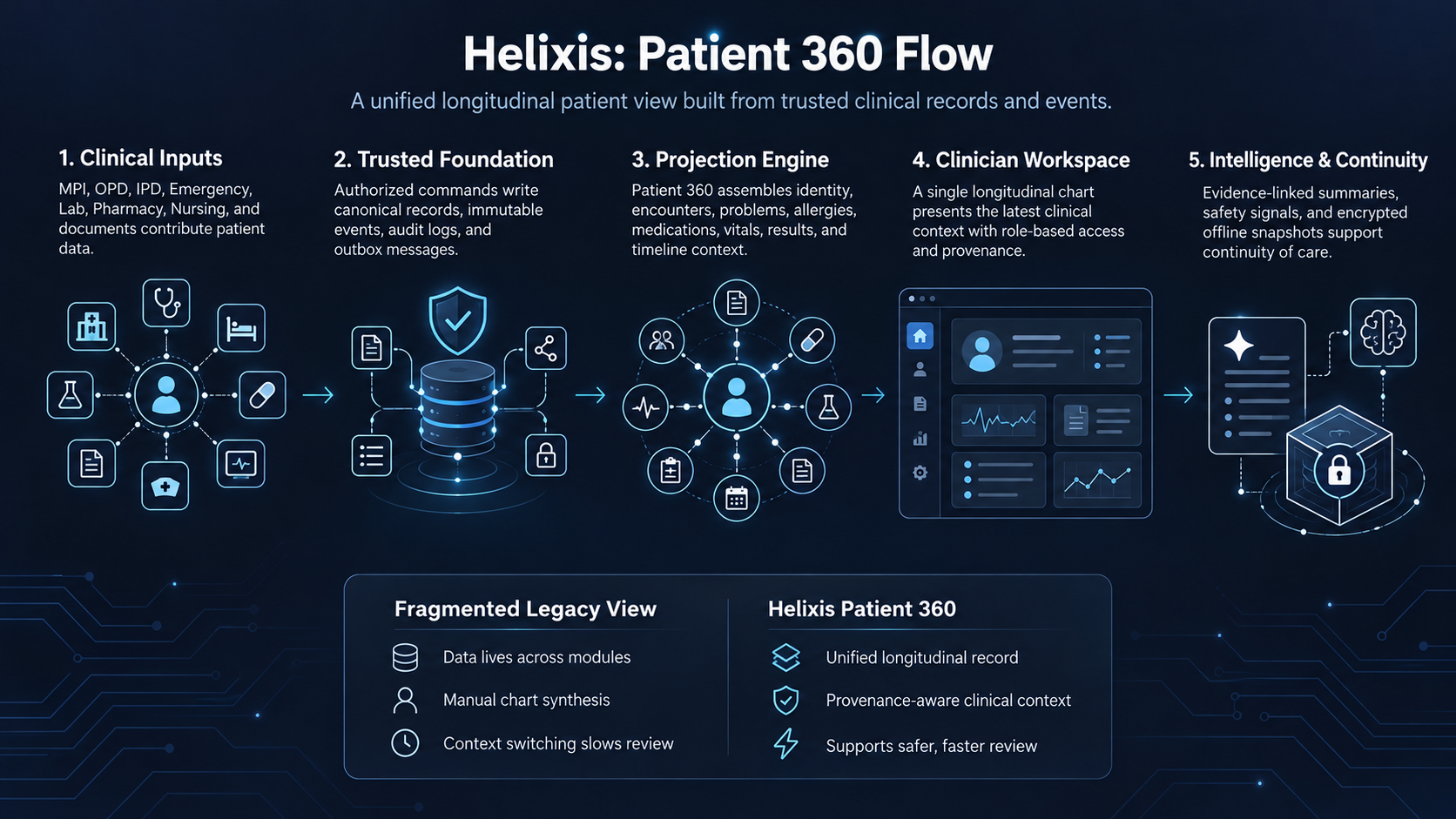
Clear clinical workflow backed by real product views.
How Helixis Clinical Intelligence unifies fragmented hospital records into a longitudinal Patient 360 chart, surfaces deterioration risks, and prepares citation-backed drafts for clinician review.
Select any stage below to inspect its clinical inputs, outputs, and safety gates
Collect & Unify Hospital Data
Multi-Department Real-Time Ingestion
Brings together patient registration, outpatient (OPD) visits, inpatient admissions, emergency triage, lab results, radiology, pharmacy dispensing, nursing vitals, and clinical documents via FHIR R4, HL7 v2, and native Helixis adapters.
- Patient registration, OPD notes & inpatient ward progress
- Emergency triage vitals, laboratory results & imaging reports
- Pharmacy medication dispensing & external discharge letters
- Validated, standardized clinical records
- Immutable ingestion log with facility & timestamp provenance
Role-based access control, single-tenant hospital isolation, and TLS 1.3 encryption in transit.
All incoming records are validated for patient identity and schema accuracy before entering Patient 360.
The 4 Questions Clinicians Ask at Every Encounter
Rather than overwhelming doctors with unverified chat text, Helixis Clinical Intelligence organizes the Patient 360 review around four clear clinical questions:
What do we know?
Consolidates confirmed active problems, allergies, chronic conditions, and current medications into a clear longitudinal view.
Hypertension, Type 2 Diabetes, and CKD (Stage 3) confirmed across prior visits. Current medications: Metformin, Amlodipine, Atorvastatin.
Draft summaries and suggested actions are presented for clinician verification. Only an authenticated physician signature writes to the medical record.
Why Workflow & Design System Consistency Matter
Beyond Standalone Language Models
Standalone AI chat tools operate outside the clinical workflow. Helixis Clinical Intelligence combines longitudinal Patient 360 views, deterministic safety checks, source citations, and clinician sign-off inside one consistent, accessible hospital interface.
| Clinical Requirement | Generic / Standalone AI | Helixis Clinical Intelligence |
|---|---|---|
| Workflow & Product View | Detached chat box that forces doctors to copy-paste notes and leaves the chart fragmented. | Integrated Patient 360 & Clinician Copilot workspace showing longitudinal trends, alerts, and actionable drafts in one view. |
| Source Provenance | Generates plausible prose with untraceable or fabricated clinical claims. | Every synthesized statement links directly to an authoritative hospital event ([EHR:ENC-102], [LAB:4092]) in one click. |
| Missing Data Handling | Silently assumes unmentioned tests are normal or overlooks overdue workups. | Classifies every clinical domain across 7 explicit InformationStates (Confirmed, Pending, Not Documented, Conflicting). |
| Safety & Rule Boundaries | Relies on prompt instructions alone, which can drift or miss medication contraindications. | Deterministic safety checks (renal dosing, drug interactions, critical labs) run independently and override AI prose. |
| Clinical Authority & Loop | No structured sign-off or closed-loop connection back to the hospital record. | Doctors review, edit, and sign every note or order; approved actions immediately update Patient 360. |
9 hospital subsystems sharing one canonical clinical & financial event log.
Interact with the cross-department workbench below or inspect each of the 9 subsystem specifications, canonical events, and authority boundaries.
Helixis Health Platform • Unified Department Views
Central Metro Hospital
Patient 360 Longitudinal Chart
Jennifer Shaw
MRN-10284 • OPD-24017 • 34 yrs • Female • Synthetic Record
Current Encounter
OPD-24017
Clinical Stage
Consultation
Deterioration Risk
Low (Stable)
Discharge Readiness
Requires review
Longitudinal Clinical Timeline
Every clinical note, vital sign, and order in chronological order
Consultation started
Dr. Sarah Jenkins
Vitals recorded
BP 126/82 • HR 78 • SpO₂ 98%
Allergy status reviewed
No known drug allergies
Consultation payment settled
Receipt RCPT-8821
Clinical Safety Summary
Discharge Hold
Pending Lab Result
Open diagnostic order remains clearly visible so nothing is missed before discharge.
Patient 360 & Clinical Intelligence
Synthesizes encounters, lab trends, and medications across 7 governed epistemic states with 1-click source citations.
Inpatient, Ward & Bed Capacity
Governed ward telemetry, real-time bed census, nursing handovers, and admission-transfer-discharge (ADT) command workflows.
Diagnostics, Laboratory & Imaging (LIS / RIS)
Closed-loop diagnostic workflows from physician order and payment gating to barcoded specimen custody, analyzer verification, and Patient 360 projection.
Hospital Pharmacy & Medical Supply Chain (SCM)
Formulary-governed prescribing, drug-interaction safety guards, FEFO batch dispensing, cold-chain telemetry, and multi-warehouse supply chain control.
Continuous Revenue Integrity & Billing
Deterministic patient revenue reconciliation uniting clinical encounters, tariffs, patient advances, insurance claims, and double-entry general ledger truth.
Offline Edge & Device Resilience
Encrypted local clinical storage, transactional outboxes, causal vector clocks, and physician conflict adjudication when hospital LAN or internet links fail.
OPD, Emergency & Clinical Workflows
High-throughput outpatient queues, emergency trauma triage, structured physician encounter notes, and cross-department clinical handoffs.
Surgical & Perioperative Operations
Operating theater scheduling, WHO surgical safety checklists, anesthesia records, surgical implant traceability, and PACU recovery coordination.
Hospital Workforce & Credentialing (HCM)
Tenant-authoritative medical credentialing, active license gates, clinical shift rostering, fatigue guardrails, and governed payroll handoffs.
Operates beside existing hospital environments.
Helixis AI connects via standard hospital network interfaces without replacing existing EHR databases. By querying hospital systems via read-only interfaces and delivering verified context to clinician terminals, hospitals gain the benefits of advanced intelligence without high-risk rip-and-replace disruption.
See the clinical context come together.
Explore a guided, interactive Helixis AI demonstration using synthetic patient information. Test the longitudinal Patient 360 workspace, trace citations, and physician sign-off gates firsthand.